Allison's 30A Blog

Hi, I’m Allison Freeman, your 30A real estate expert and local guide. This blog is where I share what I’m seeing in the market, spotlight some of my favorite neighborhoods like Seaside, WaterColor, and Rosemary Beach, and give you tips on everything from short-term rental investing to buying your dream beach home. Whether you’re thinking about making a move or just love staying in the loop, I’m here to keep you informed and inspired along Florida’s Scenic Highway 30A.

Feb. 10, 2026

Top 5 Ways Buyers Successfully Purchase on 30A Under $2 Million

By Allison Freeman, 30A Realtor
Allison Freeman, 30A Realtor

I work with buyers every week who assume purchasing on 30A under $2 million is no longer realistic. In practice, that assumption is wrong, but success at this price point requires a different approach than buyers often expect.

The buyers who succeed are not chasing perfect homes or headline listings. They understand how pricing works on 30A, where value still exists, and which tradeoffs actually matter.

Below are the five strategies I see working consistently.


1. Focus on Proximity to 30A, Not a 30A Address

One of the most effective strategies is buying near 30A rather than directly on Scenic Highway 30A.

Well-positioned homes in Seagrove Beach, Grayton Beach, and parts of Inlet Beach often provide excellent access to beaches, dining, and bike paths without the pricing premium tied to a 30A mailing address.

Buyers using this strategy frequently secure newer construction, better layouts, or stronger rental performance for the same budget.

Tradeoff to understand:
You may give up a 30A street address, but you often gain value that matters more in day-to-day use and long-term resale.


2. Be Strategic About Property Type

Under $2 million, flexibility on property type matters.

Many successful buyers choose:

  • Smaller single-family homes

  • Townhomes or duplex-style properties

  • Homes in low-density communities with shared amenities

Buyers who insist on large custom homes or expansive lots typically exceed this budget. Buyers who prioritize layout, bedroom count, and usability tend to find better opportunities.

Critical check:
HOA rules must be reviewed early, especially for short-term rental permissions, minimum stay requirements, and management restrictions.


3. Prioritize Usable Beach Access Over Gulf Views

I see buyers overpay for partial Gulf views while overlooking homes with excellent beach access.

Properties near large, well-designed public beach accesses often deliver better daily use and stronger rental appeal than homes with limited or inconvenient access points. This is especially true in parts of Santa Rosa Beach, where access quality varies significantly by location.

Second-order effect:
Families and renters consistently prioritize easy, uncrowded access over views, which directly impacts demand.


4. Buy the Right House, Not the Perfect One

Many of the best purchases under $2 million are homes that are “right,” but not finished to a magazine standard.

Successful buyers look for:

  • Solid structure and layout

  • Functional bedroom and bathroom counts

  • Cosmetic updates that can be done over time

This approach avoids bidding against buyers paying premiums for turnkey finishes while preserving upside.

Important constraint:
Major renovations on 30A can be expensive and slow due to zoning, setbacks, and permitting. Cosmetic improvements are usually the safer path.


5. Use a Hyper-Local Strategy, Not Just Online Listings

The buyers who secure the best outcomes understand that pricing on 30A is highly localized.

They:

  • Compare micro-neighborhood pricing, not just town names

  • Move quickly when the right opportunity appears

  • Evaluate long-term value instead of short-term market headlines

Many successful purchases under $2 million happen because buyers were prepared, educated, and realistic about tradeoffs before a property hit their emotional radar.

Common misconception:
Waiting for high-quality 30A homes to meaningfully “drop” in price is rarely effective. Sellers with strong assets tend to wait.


What This Means for Buyers Considering 30A

Buying on 30A under $2 million is not about settling. It is about understanding where value still exists and aligning expectations with how the market actually works.

The buyers who succeed:

  • Focus on access and usability

  • Stay flexible on finishes and property type

  • Make decisions based on local data, not national headlines

This is where local guidance matters most.


Frequently Asked Questions About Buying on 30A Under $2 Million

Can you still buy a home on 30A under $2 million?

Yes. Buyers do this regularly by focusing on proximity to 30A, flexible property types, and realistic expectations around finishes and views.

Are homes under $2 million good short-term rental investments on 30A?

They can be, but success depends on rental rules, beach access quality, bedroom count, and layout. Not all properties perform equally, even at similar price points.

Is it better to buy near 30A instead of directly on it?

In many cases, yes. Buyers often get better value, newer construction, and stronger usability just off the main corridor.

Do Gulf views matter for resale and rentals?

They matter, but usable beach access frequently matters more, especially for families and repeat renters.

Should buyers wait for prices to come down?

In my experience, well-located, high-quality properties rarely see meaningful discounts. Buyers who wait often miss the best opportunities.



Posted in 30A Vacation Homes
Feb. 5, 2026

Top 7 Characteristics of 30A Homes That Perform Well as Vacation Rentals

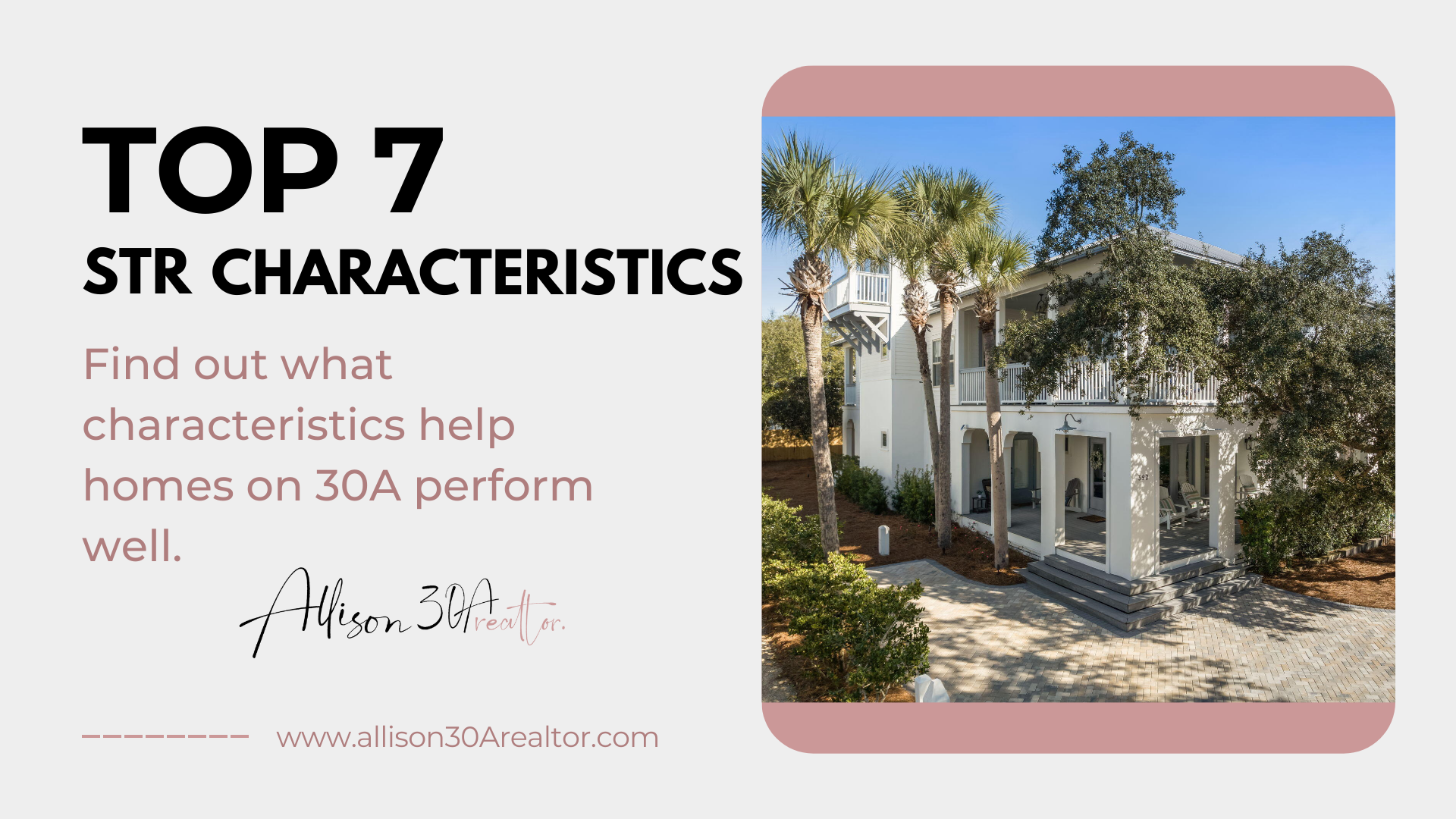
Top 7 Short-Term Rental Characteristics


Assumption to challenge:
Many buyers believe strong vacation rental performance on 30A comes from size, luxury finishes, or being as close to the Gulf as possible. In reality, rental performance is driven by how easily guests can use the home and the surrounding area.

Homes that consistently perform well along 30A tend to share the following characteristics.


1. Usable Beach Access, Not Just Distance

Being “near the beach” means very little if the access is narrow, crowded, or difficult for families to use. Homes near wide, well designed access points tend to outperform because guests value ease over technical proximity. Buyers who understand what actually makes beach access truly usable along 30A avoid overpaying for locations that look good on a map but frustrate guests in real life.


2. Strong Bike Connectivity

Along Scenic Highway 30A, bike access often matters more than drive time. Guests consistently choose homes that allow them to reach beaches, dining, and town centers safely by bike. This is why many of the qualities buyers should look for in a 30A vacation home relate to daily mobility rather than raw distance.


3. Floor Plans That Work for Groups

High performing rentals usually feature layouts that allow multiple couples or families to share the home comfortably. Separated sleeping areas, multiple bathrooms, and flexible common spaces matter far more than total square footage. Families booking vacations prioritize functionality, which mirrors the same features families prioritize in 30A vacation homes when buying for their own use.


4. Pools or Meaningful Amenities

Pools remain one of the strongest drivers of booking velocity, especially during shoulder seasons. Whether private or community based, amenities that allow guests to enjoy the property beyond beach hours significantly improve performance. This is one of the neighborhood traits that support strong short term rental demand across 30A, even in areas slightly farther from the Gulf.


5. Walkable Daily Conveniences

Homes that allow guests to walk or bike to coffee, casual dining, or shops consistently receive better reviews and repeat bookings. The convenience factor often outweighs views or interior upgrades. These walkable patterns are also among the signals that indicate a 30A home is well positioned for long term value, since usability holds up even as market conditions shift.


6. Rental Friendly Neighborhood Design

Not all 30A neighborhoods perform equally as vacation rental markets. Areas designed with density, access, and guest flow in mind tend to outperform those that were not built for transient use. Understanding which neighborhood traits support strong short term rental demand helps buyers avoid homes that struggle despite attractive pricing.


7. Long Term Value Beyond Year One

The best performing vacation rentals also make sense as long term assets. Buyers who focus on elevation, flood zone, build quality, and access resilience are better positioned to weather market cycles. These are the same signals buyers look for when evaluating long term value along 30A, not just short term income projections.


What Most Buyers Miss

  • Rental performance follows experience, not finishes

  • Beach access quality matters more than distance

  • Neighborhood design influences demand

  • Photos cannot fix poor usability

As Allison Freeman with Premier Property Group often advises, buyers who evaluate how a home actually functions as a vacation property consistently outperform those who buy based on marketing alone.


Frequently Asked Questions About 30A Vacation Rentals

What makes a 30A home perform well as a vacation rental?

Homes with usable beach access, strong bike connectivity, functional layouts, pools, and walkable conveniences tend to outperform across seasons.

Are luxury finishes required for strong rental income?

No. Durable, functional homes often outperform luxury properties that sacrifice usability for aesthetics.

Do pools really matter on 30A?

Yes. Pools increase booking demand, particularly for families and shoulder season travel.

Is walkability more important than Gulf views?

In many cases, yes. Guests value convenience and ease of movement more than views alone.

How important is neighborhood selection?

Extremely important. Neighborhood design and rental friendliness directly impact performance.


Bottom Line

Homes that perform well as vacation rentals on 30A are designed around how guests live and move during their stay. Buyers who prioritize usability, access, and neighborhood fundamentals consistently outperform those focused only on finishes or proximity.

Posted in Short-term Rental
Feb. 3, 2026

Top 5 Ways Buyers Get Seaside Proximity Without Paying Seaside Prices

Seaside Florida

Core assumption to challenge:
Many 30A buyers believe the only way to access the Seaside 30A lifestyle is to purchase inside Seaside. That assumption is costly and often incorrect.

What most 30A buyers actually want is walkability, usable beach access, rental demand, and proximity to Seaside’s amenities. Those outcomes can be achieved without paying Seaside prices if buyers focus on function rather than address.

Below are five proven ways buyers do exactly that.


1. Buy Just Outside Seaside’s Boundaries

Who this works for: Buyers who want bike and walk access to Seaside.

Neighborhoods directly east and west of Seaside provide near identical lifestyle access with a measurable price discount.

  • Why it works: Lifestyle patterns do not stop at town borders

  • Tradeoff: No Seaside architectural control or brand premium

  • Risk: Beach access quality varies by block

Critical check: Review signals that indicate long-term value near Seaside.


2. Choose Usable Beach Access Over Seaside’s Name

Who this works for: Families and short-term rental buyers.

Seaside’s beach is iconic, but beach usability matters more than branding during peak season. Homes near larger public access points can often deliver an experience on par with Seaside, but at a lower cost.

  • Why it works: Wider beaches, easier entry, less congestion

  • Tradeoff: No Seaside backdrop

  • Risk: Narrow or misleading access points

Critical check: Verify actual public beach access on foot. Do not rely on listing language. Walk the access at midday during peak season. Review what actually makes beach access usable along 30A.


3. Target Seagrove Beach or Inlet Beach

Who this works for: Buyers seeking flexibility and long term value.

Seagrove Beach and Inlet Beach consistently offer proximity, strong rental demand, and better price per square foot than Seaside.

  • Why it works: Close geography with fewer restrictions

  • Tradeoff: Less uniform aesthetics

  • Risk: Street level variance is significant

Critical check: Analyze block specific data, not neighborhood averages.


4. Buy Where Daily Needs Are Walkable, Not Just the Beach

Who this works for: Buyers who want Seaside convenience without Seaside density.

Seaside’s appeal is not just the beach. It is the ability to walk or bike to coffee, dining, shops, and events without getting in a car. Buyers can replicate much of that convenience by prioritizing neighborhoods where everyday amenities are centralized and reachable on foot or bike.

  • Why it works: Buyers and renters value frictionless daily routines, not just proximity to sand

  • Tradeoff: These areas may lack Seaside’s architectural cohesion and historic charm

  • Risk: Some walkable hubs rely heavily on HOA controlled amenities


Critical check: Confirm which amenities are truly walkable year round and which are seasonal or HOA dependent.


5. Optimize for Bike Time, Not Map Distance

Who this works for: Buyers who actually use the property.

A home slightly farther away with a safe, direct bike route can feel closer than a nearer home with poor connectivity.

  • Why it works: Bike time beats drive time along 30A

  • Tradeoff: Less spontaneous walk access

  • Risk: Seasonal traffic and unsafe crossings

Critical check: Bike the route yourself at different times of day.


What Buyers Commonly Miss

  • “Near Seaside” is not a measurable metric

  • Price per square foot ignores beach usability

  • Rental performance follows experience, not zip code

As Allison Freeman of Premier Property Group consistently advises buyers, Seaside proximity should be evaluated through daily use patterns, not marketing descriptions.


Two Viable Alternatives If None of the Above Fit

Option 1: Buy smaller inside Seaside
Higher entry cost, lower long-term risk, strongest brand preservation.

Option 2: Buy farther away with superior beach access
Lower purchase price, better family use, slightly lower rental rates.


Bottom Line

Seaside prices reflect branding and scarcity, not exclusive access to lifestyle. Buyers who define their priorities precisely can capture most of the Seaside experience without paying Seaside premiums.

If you want, next steps could include mapping these strategies to specific 30A submarkets or linking this article into your existing beach access and buyer strategy content cluster.


Frequently Asked Questions About Buying Near Seaside Without Paying Seaside Prices

Is it better to buy in Seaside or just outside of Seaside?

It depends on priorities. Buying inside Seaside offers brand prestige and strict architectural control, but buyers often pay a significant premium. Homes just outside Seaside can provide similar walkability, bike access, and rental demand at a lower price point, with fewer restrictions.

What neighborhoods are closest to Seaside without Seaside pricing?

Areas immediately surrounding Seaside, along with parts of Seagrove Beach and Inlet Beach, are commonly used by buyers seeking proximity without the premium. Exact value depends heavily on street, beach access quality, and bike connectivity.

Does “near Seaside” mean the home has good beach access?

Not necessarily. Many listings use “near Seaside” without clarifying beach access size or usability. Buyers should verify whether the access is a large public access, a narrow easement, or a private path, as this significantly affects enjoyment and rental performance.

Are short term rentals allowed near Seaside?

Rules vary by neighborhood and HOA. Some nearby communities allow unrestricted short term rentals, while others impose minimum stays or rental caps. Buyers should review HOA documents and county regulations before assuming rental eligibility.

Do rentals near Seaside perform as well as rentals in Seaside?

Often, yes. Rentals near Seaside can perform competitively if they offer easy bike access, usable beach entry, and strong amenities. In some cases, homes outside Seaside outperform due to larger floor plans, pools, or better beach access.

Is bike distance more important than walking distance along 30A?

In many cases, yes. Along Scenic Highway 30A, bike connectivity often matters more than straight line distance. A slightly farther home with a safe, direct bike route can feel more convenient than a closer home with poor access or traffic bottlenecks.

Why are Seaside prices higher than nearby areas?


Seaside prices reflect scarcity, strict design controls, and global brand recognition. They do not automatically guarantee better beach access, usability, or rental returns compared to nearby neighborhoods.

Posted in 30A Vacation Homes
Jan. 29, 2026

Top 6 Factors That Make Beach Access Truly Usable on 30A

Beach Access on 30A: Why “Technically Close” Often Isn’t Enough

One of the most common phrases buyers see in 30A listings is “close to beach access.”
What that actually means in practice can vary wildly.

Along Scenic Highway 30A, beach access ranges from wide, amenity-rich public entry points to narrow walkovers with little to no usable sand. The difference matters, especially for families, short-term rental guests, and anyone planning to spend real time on the beach.

Here are the six factors that determine whether beach access is truly usable or just technically present.


1. Width and Depth of the Accessible Beach

Not all beach access leads to the same amount of sand.

Some access points open onto wide, deep beaches where you can comfortably set up chairs, umbrellas, and games. Others funnel you onto a narrow strip of sand that can disappear entirely at high tide.

Why it matters:
A narrow beach limits usable space, increases crowding, and directly affects guest experience and rental reviews.

This is where buyers often misunderstand how neighborhood traits influence rental demand.


2. Public vs. Private Access (And What That Really Means)

This is one of the most misunderstood issues on 30A.

  • Public access typically allows use of the sand seaward of the mean high-water line.

  • Private beaches may limit where non-owners can sit, set up chairs, or stay for extended periods.

A listing can be “steps from the beach” and still leave renters unsure where they’re allowed to be.

Why it matters:
Confusion leads to complaints, confrontations, and poor guest experiences. For investors, this is a material risk, not a cosmetic one.

This ties directly into understanding short-term rental rules by neighborhood, especially where HOA or community enforcement varies.


3. Distance Is Not the Same as Walkability

Listings often quote distance in feet or blocks. That number alone is incomplete.

Ask:

  • Is the path flat or indirect?

  • Are there stairs, dunes, or road crossings?

  • Is it manageable with kids, wagons, or beach gear?

A 0.2-mile walk on paper can feel very different in real life.

Why it matters:
Families and renters value ease, not just proximity. Walkability consistently outperforms raw distance in rental performance.


4. Parking Availability at the Access Point

Some beach access points are walk-in only. Others include:

  • Dedicated public parking

  • Limited roadside spaces

  • Time-restricted or resident-only parking

If parking is limited, beach access may be effectively unusable during peak seasons.

Why it matters:
Guests who can’t park will drive elsewhere, reducing the perceived value of “near-beach” properties.

This factor is especially relevant for larger homes or groups staying farther inland.


5. Amenities at or Near the Access

Amenities dramatically change how long people stay and how often they return.

Key amenities include:

  • Restrooms

  • Showers

  • Lifeguards

  • Chair and umbrella services

  • Nearby food or drink options

An access point with amenities functions as a destination. One without them is often a short stop.

Why it matters:
Amenity-rich access supports longer beach days and stronger rental appeal, especially for families.


6. Crowding and Carrying Capacity

Even a “good” access point can become unusable if it serves too many homes.

Some access points are:

  • Oversubscribed during peak seasons

  • Shared by multiple high-density communities

  • Popular with non-local visitors

Why it matters:
Crowding affects enjoyment, safety, and the perceived quality of the beach experience.

This is rarely obvious from a listing description but becomes clear with local knowledge.


What This Means for Buyers and Investors

Beach access on 30A is not binary. It exists on a spectrum.

Two homes the same distance from the Gulf can offer completely different experiences depending on:

  • Access type

  • Beach width

  • Rules and enforcement

  • Amenities and crowding

This is why buyers working with local expertise tend to avoid surprises after closing.

As Allison Freeman, who works daily with buyers evaluating 30A vacation homes and investment properties, often explains:
“Beach access only adds value if it’s actually usable for how you plan to live or rent the home.”


Frequently Asked Questions

What does “beach access” usually mean in 30A listings?

It simply indicates a legal path to the beach. It does not guarantee usable sand, amenities, or public rights to stay in one spot.

Are public beach accesses always better?

Not always, but they tend to be more predictable. The best option depends on width, parking, and amenities.

How can buyers verify beach access usability?

By reviewing access maps, understanding local rules, and physically visiting the access during peak times.


Final Takeaway

If beach access is a deciding factor, don’t stop at distance.


Evaluate how the access works in real life, not just how it reads in a listing. That difference often determines whether a property lives up to expectations or falls short.

Posted in 30A Vacation Homes
Jan. 27, 2026

Top 10 Signals a 30A Home Is Well-Positioned for Long-Term Value

30A Homes that Have Long Term Value Graphic

When buyers talk about long-term value along Scenic 30A, they are usually blending several ideas together: resale strength, rental durability, lifestyle relevance, and downside protection. Those are related, but they are not the same thing.

Some homes look fantastic in the current market and age poorly. Others appear conservative at first glance but quietly compound value across market cycles.

When advising buyers along 30A, Allison Freeman evaluates homes using a longer lens. The goal is not to predict short-term appreciation, but to identify properties that remain desirable even as buyer preferences, regulations, and market conditions change.

Below are ten signals that consistently show up in 30A homes that hold value over time.


1. The location still works if the market shifts

A strong long-term location does not rely on one narrow buyer story.

Homes that age well tend to be:

  • Walkable or bikeable to places people actually use

  • Close to stable, legal public beach access

  • Functional even if short-term rental demand softens

These fundamentals overlap heavily with the same qualities that consistently show up in well-performing 30A vacation homes over time, regardless of market cycle. Locations near established communities like Seaside and Rosemary Beach have historically benefited from diversified buyer demand rather than dependence on a single use case.


2. Beach access is clear, practical, and defensible

Beach access” is one of the most misunderstood phrases in 30A real estate.

A home is better positioned for long-term value when:

  • The nearest public access is clearly defined

  • The distance is reasonable for daily use

  • The access point offers usable frontage

Buyers often underestimate how much future buyers will scrutinize access. A vague description today can become a pricing objection later.


3. The floor plan works beyond vacation weeks

Layouts designed only for short stays tend to lose appeal over time.

Homes that hold value typically include:

  • Bedrooms that work for adults, not only bunks

  • Bathrooms that support longer stays

  • Living spaces that function when the home is full

These layouts align closely with the features families and second-home buyers consistently prioritize in 30A vacation properties, even if those buyers never plan to rent the home.


4. The home appeals to more than one buyer type

The widest buyer pool usually provides the strongest pricing support.

Homes that can transition between:

  • Primary residence

  • Second home

  • Short-term rental, where allowed

tend to outperform homes that only make sense for one narrow use. Flexibility matters more as markets normalize.


5. Lot characteristics add value that cannot be recreated

Finishes can be changed. Lots cannot.

Positive long-term signals include:

  • Outdoor space that can be improved over time

  • Orientation that supports natural light and livability

  • Privacy that is not dependent on vacant neighboring parcels

Once surrounding lots are built out, these advantages become permanent differentiators.


6. HOA and neighborhood rules are stable and aligned

Regulatory risk is real along 30A, especially around rentals, parking, and usage.

Homes with stronger long-term positioning are usually located in communities where:

  • HOA documents are clear and historically consistent

  • Neighborhood identity matches the rules

  • Buyers can easily understand what is allowed

Uncertainty eventually shows up in pricing, even if it is ignored during hot markets.


7. Construction quality shows up in the unglamorous details

Long-term value is often protected by elements buyers do not see in listing photos.

Pay attention to:

  • Roof age and build quality

  • Windows, doors, and water management

  • HVAC history and maintenance

A home can photograph beautifully and still become a future expense burden. Buyers tend to pay more over time for homes that feel solid, not just styled.


8. The home is not over-customized for narrow tastes

Highly personalized finishes can age quickly and shrink the future buyer pool.

Homes positioned for long-term value usually feature:

  • Timeless materials

  • Neutral, flexible palettes

  • Quality execution over trend-driven design

This does not mean generic. It means adaptable.


9. The price per square foot is supported by micro-location

On 30A, micro-location often matters more than the neighborhood label.

Stronger long-term signals appear when:

  • Pricing aligns with nearby comparable homes

  • Premiums are justified by access, walkability, or setting

  • Value is supported by fundamentals, not optimism

Overpaying within the wrong micro-location is one of the fastest ways to cap future upside.


10. It feels desirable without a long explanation

This signal is subjective, but it consistently shows up in real transactions.

Homes that hold value tend to create confidence quickly. If a buyer needs repeated justification to feel comfortable, that hesitation often resurfaces when it is time to sell.

Part of Allison Freeman’s role as you local 30A realtor is helping buyers on 30A distinguish between true long-term advantages and stories they are telling themselves in the moment.


What This Means for 30A Buyers

If long-term value matters, prioritize durable fundamentals over short-lived excitement. Paying a premium is not always the mistake. Paying a premium for strengths that do not last usually is.

What This Means for 30A Sellers

30A homes with strong fundamentals are easier to position, easier to explain, and easier for buyers to trust. Long-term value signals tend to translate directly into shorter negotiation cycles and stronger offers.


FAQ

What matters most for long-term value on 30A?

Location fundamentals. Usable beach access, walkability, and neighborhood stability tend to outweigh interior trends over time.

Does short-term rental potential guarantee long-term value?

No. Rental demand can help, but long-term value is stronger when the home also appeals to non-renter buyers. Rules and preferences change.

Why does floor plan matter so much?

Layouts that support everyday living attract a broader range of buyers, which protects pricing across different market conditions.

Are newer homes always better positioned?

Not necessarily. Build quality, lot characteristics, and neighborhood context matter more than age alone.

What is a common buyer mistake?

Overvaluing short-term excitement and undervaluing fundamentals that only become obvious years later.


CTA

If you are evaluating a 30A home and want to pressure-test its long-term positioning before committing, Allison Freeman works with buyers across the Scenic 30A corridor to identify durable value and avoid quiet mistakes.

Reach out to discuss whether a property’s fundamentals support where you want to be five or ten years from now.

Posted in 30A Neighborhoods
Jan. 22, 2026

Top 7 Features Families Prioritize in 30A Vacation Homes

Top 7 30A Family Vacation Homes

Families represent one of the most consistent sources of demand along Scenic 30A. They book longer stays, return to properties they trust, and prioritize usability over novelty. For buyers considering a vacation home that will be used personally and rented to others, understanding what families actually prioritize is essential.

According to Allison Freeman, a luxury real estate advisor who works daily with second-home and short-term rental buyers along 30A, the strongest-performing homes are often the most stylized and are ones that remove friction for real-life vacation use and hold up over time.

The features below consistently show up in family booking behavior, buyer feedback, and long-term ownership satisfaction.


1. Simple and Predictable Beach Access

Families prioritize beach access that is easy to understand and easy to use.

A slightly longer walk with sidewalks, safe crossings, and a clear public access often outperforms a technically closer route that requires navigating traffic or private easements. When traveling with children, strollers, and beach gear, predictability matters more than distance alone.

This is one reason homes near established public beach accesses or within walkable communities tend to see stronger family demand.

This is why homes near established public beach accesses or within walkable communities tend to see stronger family demand, a pattern that shows up consistently in 30A neighborhood traits that support strong short-term rental demand. 

2. Functional Sleeping Layouts, Not Just Bedroom Count

Families care less about how many bedrooms a home has on paper and more about how those rooms actually function.

Bunk rooms, secondary living areas with sleeper sofas, and layouts that allow parents and children to spread out matter more than oversized primary suites. Homes that sleep eight comfortably often outperform homes that technically sleep ten but feel tight or awkward.

Multi-family trips are common on 30A, and layouts that accommodate them without friction perform better.

3. Enough Bathrooms to Avoid Bottlenecks

Bathrooms are a deciding factor for families, even if buyers underestimate them initially.

Homes with multiple full baths, hall-accessible bathrooms, and practical layouts reduce congestion during mornings and evenings. Jack-and-jill designs and outdoor showers also improve usability for beach days.

From a rental standpoint, bathroom count has a direct impact on reviews and repeat bookings.

4. Pool or Reliable Pool Access

For families, a pool is not a luxury feature. It is a core expectation.

Private pools and well-maintained community pools provide flexibility when beach conditions are less favorable or when kids need a break from the sand. Heated pools extend usability into shoulder seasons and improve off-season demand.

Allison Freeman often advises buyers that pool access is one of the few features that consistently influences booking decisions across multiple seasons.

5. Open Living Areas With Clear Sightlines

Families gravitate toward homes that allow shared time without feeling crowded.

Open kitchens connected to dining and living spaces make it easier for adults to relax while keeping an eye on children. Clear sightlines support how families actually use vacation homes.

Layout considerations like these are part of the broader set of fundamentals buyers should evaluate early in the process, especially when reviewing the top qualities buyers look for in a 30A vacation home.

6. Easy, Adequate Parking

Parking is an overlooked but critical feature for family travelers.

Families often arrive with multiple vehicles and significant gear. Homes with intuitive parking, room to unload, and minimal restrictions create a better first impression and fewer operational issues.

Properties that rely on limited street parking or complicated access tend to underperform with family guests.

7. Proximity to Town Centers and Everyday Amenities

Families value convenience more than isolation.

Being near bike paths, restaurants, ice cream shops, and gathering spaces reduces the need for constant driving. Older children benefit from walkable areas, and parents appreciate the flexibility.

Homes near established town centers along 30A consistently benefit from stronger repeat demand.

Why These Features Matter for Buyers

These priorities are not trends. They reflect how families actually travel and use vacation homes.

Buyers who align their purchase decisions with these features tend to experience:

  • More consistent rental demand

  • Fewer usability complaints

  • Broader resale appeal

  • Better long-term ownership satisfaction


Frequently Asked Questions About 30A Vacation Homes for Families

What features matter most to families renting vacation homes on 30A?

Families consistently prioritize easy beach access, flexible sleeping arrangements, multiple bathrooms, pool access, and open living areas. 

Do family-friendly vacation homes perform well as short-term rentals?

Yes. Many features families prioritize overlap directly with what supports strong short-term rental demand, particularly walkability, pools, and functional layouts. These traits often align with neighborhood-level demand patterns across 30A.

Is it better to buy a larger home for family rentals?

Not necessarily. Homes with efficient layouts and flexible sleeping arrangements often outperform larger homes with poor flow. Allison Freeman frequently advises buyers to evaluate how a home lives rather than focusing on square footage alone.

Are private pools more important than beach proximity?

Families value flexibility. While beach access is important, pool access plays a major role in booking decisions, especially during shoulder seasons or when beach conditions are unpredictable.

How should buyers evaluate a vacation home they plan to use with their own family?

Buyers should evaluate homes through both a personal-use and market-appeal lens. Features that work well for family travel tend to support rental performance and resale value, making foundational buyer criteria especially important early in the process.

Posted in 30A Vacation Homes
Jan. 20, 2026

Top 10 30A Neighborhood Traits That Support Strong Short-Term Rental Demand

Not every home along Scenic Highway 30A performs well as a short-term rental. In fact, many do not. Strong demand is not accidental; it is driven by a repeatable set of neighborhood-level characteristics that influence how often a property books, what nightly rates it can command, and how resilient demand remains across market cycles.

According to Allison Freeman, a luxury real estate advisor specializing in the 30A market, this is where many buyers misjudge risk. She often sees strong homes underperform simply because the surrounding neighborhood does not support consistent short-term rental demand.

Below are the ten traits Allison consistently sees in 30A neighborhoods that support durable short-term rental demand. This is written from the perspective of buyers evaluating investment risk and sellers positioning their property correctly, not from marketing theory.


1. Walkable or Bike-Friendly Access to Amenities

Neighborhoods that allow guests to reach the beach, dining, shopping, and entertainment without getting in a car consistently outperform car-dependent locations.

Why it matters:

  • Vacationers value convenience more than square footage.

  • Walkability reduces friction for families and groups.

  • It shows up directly in reviews, repeat bookings, and length of stay.

Key indicator: proximity to beach access combined with restaurants or town centers reachable by foot or bike.


2. Clearly Defined, Usable Beach Access

“Beach access” on paper is not the same as usable access in practice. High-performing neighborhoods offer:

  • Dedicated, nearby beach walkovers

  • Reasonable spacing between access points

  • Adequate beach width for actual use

Properties in neighborhoods with constrained or misleading access often underperform expectations, even if the home itself is well-appointed.


3. Short-Term Rental-Friendly HOA Rules

This is foundational. Neighborhoods that explicitly allow short-term rentals without onerous restrictions are inherently more attractive to investors.

Red flags include:

  • Minimum stay requirements that eliminate weekend demand

  • Caps on the number of rental permits

  • HOA boards with discretionary approval authority

Demand follows clarity. Investors and guests alike avoid uncertainty.


4. Cohesive Neighborhood Identity

Neighborhoods with a recognizable name, aesthetic, or reputation tend to book better than anonymous pockets of homes.

Why this matters:

  • Guests search by area familiarity, not street name

  • Brand recognition reduces perceived risk when booking

  • Strong identity supports higher ADR over time

This does not require luxury. It requires cohesion and consistency.


5. On-Site or Community Amenities Guests Actually Use

Pools, green spaces, trails, and gathering areas materially impact booking velocity, especially for families.

Amenities that consistently support demand:

  • Community pools or private pools

  • Bike paths and trails

  • Central green spaces or plazas

Amenities that look good in listings but rarely move demand are less valuable than many buyers assume.


6. Inventory That Matches Guest Preferences

Neighborhoods dominated by the right unit types tend to perform better:

  • 3–5 bedroom homes

  • Flexible sleeping arrangements

  • Outdoor living space

Areas with a mismatch between typical guest group size and housing stock struggle to maintain high occupancy, even in peak season.


7. Reasonable Density Without Overcrowding

There is a balance. Too sparse and the area feels isolated. Too dense and guests perceive congestion.

High-performing neighborhoods strike a middle ground:

  • Enough homes to support services and amenities

  • Not so many that parking, noise, and congestion become common complaints

This balance supports both guest satisfaction and HOA stability.


8. Proximity to Established 30A Towns Without the Price Premium

Neighborhoods that sit just outside iconic 30A towns often perform extremely well because guests can access the lifestyle without paying top-tier rates.

From an investment standpoint:

  • This supports higher occupancy

  • It reduces downside risk during slower demand periods

  • It expands the potential guest pool

This is one of the most commonly misunderstood dynamics among first-time buyers.


9. Consistent Aesthetic Standards

Neighborhoods with architectural guidelines and maintained common areas tend to age better in rental performance.

Why:

  • Photos remain competitive over time

  • Guests perceive quality before they ever arrive

  • Review scores stay more stable

Inconsistent aesthetics introduce performance volatility that does not show up in initial projections.


10. Proven Rental Track Record in the Area

The strongest indicator of future demand is past demand, but only when interpreted correctly.

What matters:

  • Consistent bookings across multiple years

  • Performance relative to nearby neighborhoods, not just raw revenue

  • Stability through slower seasons

Neighborhood-level data is often more predictive than property-specific projections.


What This Means for Buyers and Sellers

For buyers:
Do not evaluate short-term rental potential in isolation. Neighborhood traits often matter more than finishes, furnishings, or even proximity measured in feet. Be aware of what tools can help you price your 30a short-term rental.

Buyers evaluating short-term rental potential should also understand the qualities buyers should look for in a 30A vacation home, since property-level decisions compound or limit neighborhood performance.

For sellers:
If your neighborhood aligns with several of these traits, that should be reflected in pricing strategy and marketing language. If it does not, expectations need to be recalibrated early to avoid prolonged days on market.

In the 30A market, short-term rental demand is structural, not guaranteed. Understanding which neighborhood traits support that demand is the difference between owning a lifestyle asset that works and one that merely looks good on paper.

If you want a neighborhood-specific breakdown through this lens, that is where meaningful analysis begins. 

Posted in Short-term Rental
Jan. 16, 2026

Top 10 Qualities Buyers Should Look for in a 30A Vacation Home

Top 10 Qualities 30A STRs

Buying a vacation home along Scenic 30A is not just a real estate decision. It is a lifestyle decision that carries long-term financial and usability implications. Buyers who focus only on aesthetics or proximity to the beach often overlook the underlying qualities that determine whether a home actually works over time.

According to Allison Freeman, a luxury 30A real estate advisor who works with second-home and vacation buyers along 30A every day, the most successful purchases tend to look less “perfect” on day one and perform better over the long run.

This guide breaks down the core qualities buyers should evaluate before purchasing a vacation home on 30A, based on real buyer behavior, ownership outcomes, and long-term demand patterns.


How These Qualities Were Evaluated

The qualities below are based on:

  • What buyers consistently value after owning for several years

  • How homes function during peak and off-season use

  • Neighborhood dynamics unique to the 30A market

  • Rental usability without assuming rental dependence

  • Resale behavior across different market cycles

This list focuses on decision quality, not trends.


1. Usable Beach Access, Not Just Distance

One of the most common mistakes buyers make is assuming that closer always means better. On 30A, usable beach access matters more than raw proximity.

Buyers should evaluate:

  • Location of public beach access points

  • Parking availability and congestion

  • Boardwalk condition and distance

  • Ease of use for guests unfamiliar with the area

Homes slightly farther from the Gulf but near reliable access points often provide a better ownership experience than homes technically closer with limited or inconvenient access.

Key takeaway: Convenience beats distance.


2. A Floor Plan That Supports Real Use

Vacation homes are used differently than primary residences. Strong floor plans typically include:

  • Separation between sleeping areas

  • Adequate bathroom count relative to beds

  • Common spaces that accommodate groups comfortably

Layouts that feel tight, overly segmented, or dependent on perfect weather tend to frustrate owners over time.


3. Flexibility for Changing Use Over Time

Many buyers purchase with one use case in mind and later adjust. A well-positioned vacation home should still work if:

  • Personal use increases or decreases

  • Guests change from couples to families

  • Rental use becomes more or less important

Homes that only function well in a narrow scenario reduce long-term optionality.


4. Maintenance That Matches Coastal Reality

The 30A environment is demanding. Salt air, humidity, and seasonal occupancy accelerate wear.

Buyers should prioritize:

  • Durable exterior materials

  • Simple rooflines

  • Practical finishes over delicate ones

  • Landscaping that does not require constant attention

As Allison Freeman often advises buyers, low-maintenance decisions made at purchase tend to matter far more than cosmetic upgrades later.


5. Outdoor Space That Is Actually Usable

Outdoor living is part of the appeal of 30A, but not all outdoor space is created equal.

Functional outdoor areas typically offer:

  • Shade or covered elements

  • Privacy from neighboring homes

  • Logical flow from indoor living spaces

Large but exposed outdoor areas are frequently underused.


6. Neighborhood Consistency and Character

Neighborhood dynamics influence both enjoyment and long-term value.

Buyers should pay attention to:

  • Density and traffic patterns

  • Mix of full-time owners and visitors

  • Overall feel during peak season versus off-season

Consistent neighborhoods tend to experience steadier demand and fewer ownership surprises.


7. Predictable HOA Rules and Fees

HOAs are neither inherently good nor bad, but unpredictability is a risk.

Buyers should understand:

  • Rental rules and enforcement history

  • What fees actually cover

  • How fees have changed over time

Predictability matters more than the presence or absence of an HOA.


8. Parking and Arrival Experience

Parking is often overlooked during showings but quickly becomes a daily issue.

Strong vacation homes offer:

  • Clearly defined parking

  • Guest-friendly access

  • Minimal friction during busy periods

Ease of arrival significantly impacts guest and owner experience.


9. Comfort Outside Peak Summer Months

Homes that only feel enjoyable during summer often lose appeal.

Buyers should look for:

  • Comfortable interior gathering spaces

  • Natural light during shorter days

  • Layouts that support year-round use

Homes that work in shoulder seasons tend to age better in resale.


10. Price Alignment With Utility, Not Just Location

Paying a premium for a recognized area does not always translate to satisfaction.

Smart buyers evaluate:

  • How often the home will realistically be used

  • Which features will actually matter day to day

  • Whether price reflects function, not just branding

Value is created when utility and price align.


What This Means for 30A Buyers

The strongest vacation home purchases on 30A are rarely the most obvious ones. Buyers who prioritize usability, flexibility, and long-term ownership experience tend to feel confident in their decisions well beyond the initial excitement.

As Allison Freeman, 30A Realtor, often notes when guiding buyers through the process, the goal is not to buy the most talked-about home, but the one that continues to make sense years later.


Frequently Asked Questions

What makes a good vacation home on 30A?
Usable beach access, functional layout, manageable maintenance, and flexibility over time.

Do vacation homes on 30A need to be rented to justify the purchase?
No. Many buyers prioritize lifestyle first, with rental flexibility as a secondary benefit.

Is buying a vacation home on 30A still worth it?
For buyers focused on long-term use and lifestyle alignment, demand remains consistent.


Last updated January 2026 to reflect current buyer behavior and ownership considerations along Scenic 30A.

Posted in 30A Vacation Homes
Jan. 12, 2026

Top 5 Metrics Every Short-Term Rental Owner Should Know

Allison Freeman, Top 5 Metrics Every Short-Term Rental Owner Should Know

I own short-term rentals. I also work with buyers every day who want a property that looks like a great investment on paper. Those two perspectives matter, because the biggest mistake I see owners make is tracking numbers without understanding what they are actually telling them.

High bookings do not automatically mean high profits. And one “good” metric in isolation can easily mask a weak business underneath.

If you want to run a short-term rental like an asset and not a hobby, these are the five metrics you need to understand cold, and more importantly, how they work together.

Key Takeaway:

The most important short-term rental metrics are occupancy rate, average daily rate (ADR), revenue per available night (RevPAR), net operating income (NOI), and cash-on-cash return. Together, these metrics show demand, pricing efficiency, profitability, and return on invested capital. Successful owners evaluate how these numbers interact rather than relying on bookings or revenue alone. Not every neighborhood performs the same. Find out which 30A neighborhoods support strong short-term rental demand.


1. Occupancy Rate

What it tells you: Demand and market fit
What it does not tell you: Profitability

Occupancy rate measures the percentage of available nights that are booked.

Formula:
Booked nights ÷ available nights × 100

A strong occupancy rate means your pricing, presentation, and marketing are aligned with demand. A weak one usually signals one of three things: pricing is off, the listing is not competitive, or the property does not match what renters in that market actually want.

The mistake I see often is owners chasing occupancy at all costs. Discounting your way to a full calendar can look productive while quietly eroding margins.

How to use it properly:
Use occupancy as a diagnostic tool, not a success metric. If occupancy is high but cash flow is weak, pricing or expenses are the problem. If occupancy is low, fix demand before touching anything else.


2. Average Daily Rate (ADR)

What it tells you: Revenue efficiency per night
What it does not tell you: Overall performance

ADR is the average revenue earned per booked night.

Formula:
Total booking revenue ÷ booked nights

ADR reflects how the market values your property. Amenities, design, location, seasonality, and guest experience all show up here.

A higher ADR with slightly lower occupancy can often outperform a lower ADR with a full calendar. This is where professional operators separate themselves from casual hosts.

How to use it properly:
Track ADR alongside occupancy. If ADR is falling while occupancy rises, you are likely underpricing. If ADR is strong but bookings slow, you may be priced ahead of the market or poorly positioned against competitors.


3. Revenue Per Available Night (RevPAR)

What it tells you: How well the property monetizes its calendar
Why it matters: It balances volume and pricing

RevPAR combines occupancy and ADR into a single performance metric.

Formula:
ADR × occupancy rate
or
Total booking revenue ÷ available nights

This is one of the most useful metrics for comparing performance across time, across properties, or against a market average. It removes the temptation to fixate on just bookings or just nightly rate.

How to use it properly:
If RevPAR is rising, your pricing and demand strategy is working. If it is flat or declining, something is misaligned. RevPAR is especially valuable when evaluating pricing changes, renovations, or management decisions.


4. Net Operating Income (NOI)

What it tells you: Real profitability before financing
Why it matters: This is where owners get honest with themselves

NOI is your income after operating expenses, before mortgage payments and taxes.

Formula:
Gross operating revenue − operating expenses

Operating expenses include cleaning, maintenance, utilities, supplies, management, software, and routine repairs. NOI exposes inefficiencies quickly. Rising revenue with flat NOI means expenses are quietly expanding.

How to use it properly:
Review NOI trends, not just totals. If revenue grows but NOI does not, focus on cost control, vendor renegotiation, and operational efficiency before chasing more bookings.


5. Cash-on-Cash Return

What it tells you: Return on your actual cash invested
Why it matters: This is the investor reality check

Cash-on-cash return measures how much cash flow you generate relative to the cash you put into the deal.

Formula:
Annual cash flow ÷ initial cash investment × 100

This metric matters because leverage changes everything. Two properties with identical revenue can produce very different returns depending on financing, down payment, and operating structure.

How to use it properly:
Cash-on-cash is most useful when comparing opportunities or evaluating whether a property still justifies the capital tied up in it. If this number compresses over time, your money may be working harder elsewhere.


The Bigger Picture Most Owners Miss

No single metric tells the full story. Occupancy without ADR is misleading. Revenue without NOI is incomplete. Cash-on-cash without operational context is risky.

The owners who perform best are not the ones checking dashboards daily. They are the ones who understand why the numbers move and know exactly which lever to pull when they do.

If you understand these five metrics and how they interact, you are already operating at a higher level than most short-term rental owners.

Short-Term Rental Metrics FAQs

What is the most important metric for short-term rental owners?

There is no single most important metric. Occupancy rate, ADR, RevPAR, NOI, and cash-on-cash return must be evaluated together. Focusing on one metric in isolation often leads to misleading conclusions about performance.

Is high occupancy always a good thing for a short-term rental?

No. High occupancy with low nightly rates can reduce profitability. A balanced strategy that optimizes both occupancy and pricing typically produces stronger returns.

What is RevPAR and why does it matter?

RevPAR, or revenue per available night, measures how efficiently a property generates revenue across its calendar. It combines occupancy and ADR, making it one of the best indicators of overall performance.

How do I know if my short-term rental is actually profitable?

Profitability is best measured through Net Operating Income (NOI) and cash-on-cash return. Revenue alone does not account for operating costs, financing, or capital invested.

Do short-term rental metrics change by market?

Yes. Metrics vary widely by location, seasonality, property type, and demand drivers. Comparing your numbers to market-specific benchmarks is critical for accurate decision-making.


About Allison Freeman

Allison Freeman is a top-producing 30A real estate agent with The Premier Property Group, specializing in luxury real estate and Florida beach homes for sale along Scenic Highway 30A. She advises buyers and sellers on 30A homes for sale, 30A vacation homes, and luxury beach vacation homes, pairing deep local knowledge with a data-driven approach to pricing and negotiation.

Posted in 30A News
Dec. 17, 2025

Airbnb Pricing Strategy for 2026: Tools, Data, and What Actually Works on 30A

Updated: December 17, 2025

Short-term rental pricing has changed fast. Heading into 2026, the gap between high-performing properties and struggling ones is widening. In competitive coastal markets like Seaside in FL, Watersound Florida, and nearby 30A communities, pricing mistakes are no longer small. They directly impact occupancy, cash flow, and long-term viability.

The market sets the price in real time

Guests decide what a property is worth every time they search. They compare nightly rates, photos, reviews, and availability across dozens of listings. Value shifts based on seasonality, competition, and how close the stay dates are.

The fastest way to lose revenue

Anchoring to a number that feels deserved often leads to empty nights. Short-term rentals do not have one correct price. They have a range that moves throughout the year.

Tools to help determine nightly rates

Pricing software is a starting point

Pricing tools respond to the rules they are given. Unrealistic base rates, tight minimums, and overbuilt rulesets limit effectiveness. The strongest results come from simple setups that evolve with real booking behavior.

Using Airbnb Wishlists for comps

Wishlists allow you to save comparable listings and see real-time availability and pricing for specific dates. This reflects what guests actually see during their search.

Lead time and pricing zones

Bookings made months out behave differently than last-minute reservations. Most properties perform best within a defined lead-time window.

Why weekdays struggle

Weekend demand stabilizes first. As inventory grows, weekday demand often lags, creating heavier competition Monday through Thursday.

Structure bookings strategically

Instead of broad discounts, successful hosts bundle midweek nights with longer stays and target orphan nights created by existing bookings.

Price with probability

Tracking the lowest prices that consistently convert creates reliable booking floors. Closer to check-in, certainty often outperforms optimism.

FAQ

What is the best Airbnb pricing strategy for 2026?

Use dynamic pricing tools with realistic base rates, flexible minimums, real-time comps, and regular review.

Which tools help price short-term rentals?

PriceLabs, Wheelhouse, Beyond Pricing, AirDNA, and Airbnb Wishlists are commonly used together.

Why do weekdays book slower?

Inventory growth often outpaces weekday demand in vacation markets, increasing competition.

Posted in Market Updates